
How Annual CX Analysis Helps Banks Prioritize What Matters
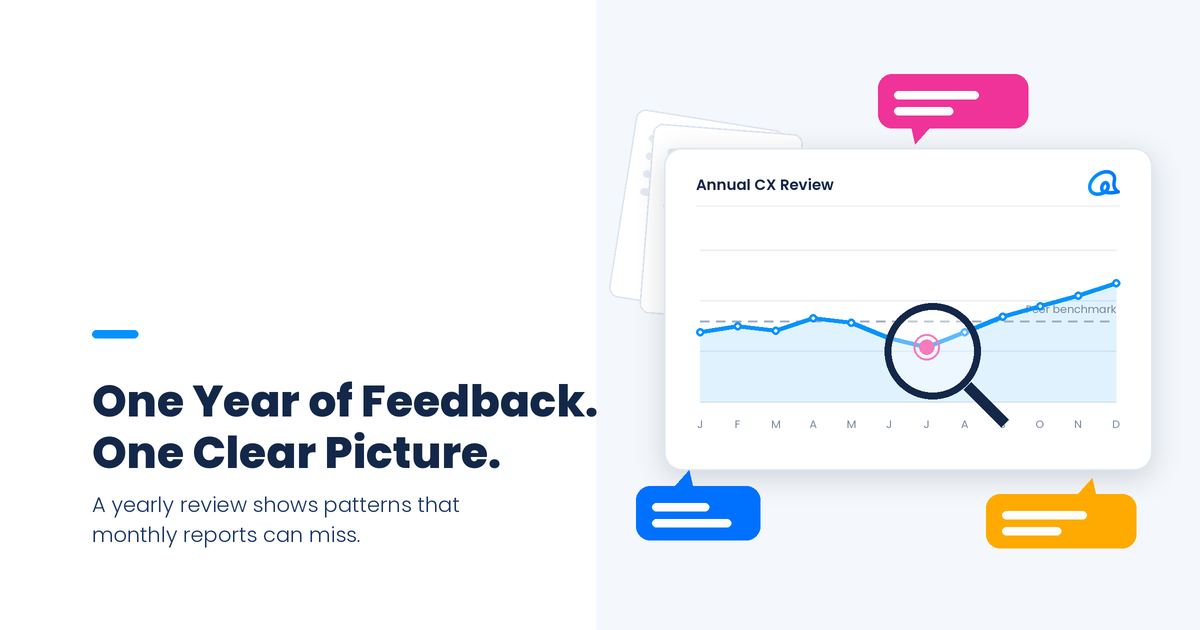
Monthly and quarterly reporting help community financial institutions (CFIs) keep an eye on performance and emerging concerns. However, reviewing results report by report does not always provide the distance or context needed to see the complete picture. A score may move slightly between quarters without indicating a meaningful trend, while a stable touchpoint may be consistently underperforming compared to similar institutions.
Performing an annual customer experience (CX) review allows a CFI to see a full year of results together with customer comments, industry benchmarks, and broader banking trends. That additional context can help a CFI spot larger patterns and prioritize opportunities, as well as determine whether concerns such as wait times or confusing processes point to a need for better training, additional staffing, or new technology.
BENCHMARKS PUT PERFORMANCE IN CONTEXT
Customer feedback scores become more useful when they’re compared against relevant benchmarks. You can learn more about benchmarking for CFIs in this article, but in short, they help leadership understand whether their own results are strong, within an expected range, or potentially concerning.
For example, a bank may see that customers report frustration with logging into the app on the digital channel survey, while the closed account survey indicates an increase in clients closing accounts due to a recent branch closure.
Viewed separately, scores provide useful information. Viewed together, and with the context of comparable financial institutions, they offer clearer direction about where to maintain momentum and where a deeper look could be valuable. In the case of the CFI in our example, an annual review can help the organization understand how digital access and assistance mitigate changes to the physical footprint.
WHAT AN ANNUAL DATA REVIEW CAN INCLUDE
An annual review brings together information that may otherwise be spread across numerous dashboards and reports. Depending on the institution and its goals, the analysis may include:
- Bankwide KPIs around service and experience.
- Score movements over time, along with areas performing above/below industry averages.
- Key themes from customer verbatims, including products or features requested..
- Competitive wins or concerns.
- Suggested areas for deeper research.
- Prioritized recommendations for leadership discussion.
The goal is to bring the findings together, so leadership can understand which results matter most and how they may relate to one another.
ANNUAL ANALYSIS HELPS CFIs PRIORITIZE
A year of listening data can produce a very long potential to-do list. Annual analysis narrows that list into a focused set of priorities that are most likely to impact the customer experience.
Correlation analysis, verbatim review, score trends, and industry expertise all contribute to that process. For example, the analysis may show that a service behavior like using a client’s name has room for improvement in both the teller and contact center experiences. Because the same pattern appears across multiple touchpoints, it may indicate an opportunity for broader coaching or training.
The review may also find that requests for a particular product or feature — such as peer-to-peer networks like Zelle in the mobile app — are appearing more frequently in customer comments. A few isolated requests might not seem urgent, but a growing pattern, especially when considered alongside industry trends, could point to a larger competitive concern.
In both cases, the value comes from connecting individual findings to the broader CX rather than treating each score or comment as a separate issue.
OUTSIDE EXPERTISE CAN ADD CLARITY
Plenty of CFIs have employees who understand data and know their institution extremely well. They can and do annually review data (and do a fine job of it). However, internal teams are often spread thin, and taking on the additional, often weeks-long burden of building an annual review is not possible.
In situations like these, we recommend checking with your CX provider for a resource — specifically one with expertise in financial institutions. Some CX outfits only do data collection, or put analysis at a very high price point; others, however, do offer a high level of expert support as part of their service or at reasonable additional cost.
An outside reviewer can bring a degree of objectivity. Internal teams naturally view data through the lens of current initiatives and developmental priorities. Someone removed from those day-to-day considerations may notice connections that are easy to overlook internally, validate concerns the team has already identified, or offer a different interpretation.
The consultant does not replace the institution’s internal knowledge. Outside expertise adds context to that knowledge, helping a CFI move from a collection of findings to a clearer set of decisions.
COLLECTING FEEDBACK IS THE FIRST STEP
CFIs should take a deeper look at their listening data at least once a year. An annual review provides a more complete view of the customer experience, supported by benchmarks, trend analysis, verbatims, and industry perspective.
More importantly, it assists the institution understand what is working and what may need attention. Avannis’ reporting tools provide everything a CFI needs to create an annual review on their own. And if your organization wants some outside help, we’re always ready to support you with our industry insights and decades of experience.
Want to learn more about what Avannis can do for your bank? Schedule a demo. We can’t wait to meet you.
Avannis reporting tools provide everything a bank needs to create the review themselves, but that we’re always ready to support with our industry insights and experience.
An annual review is also the fastest way to spot a slide before it becomes a trend, which is covered in why your institution’s scores might be dropping.