
Why Benchmarking Matters in Customer Feedback
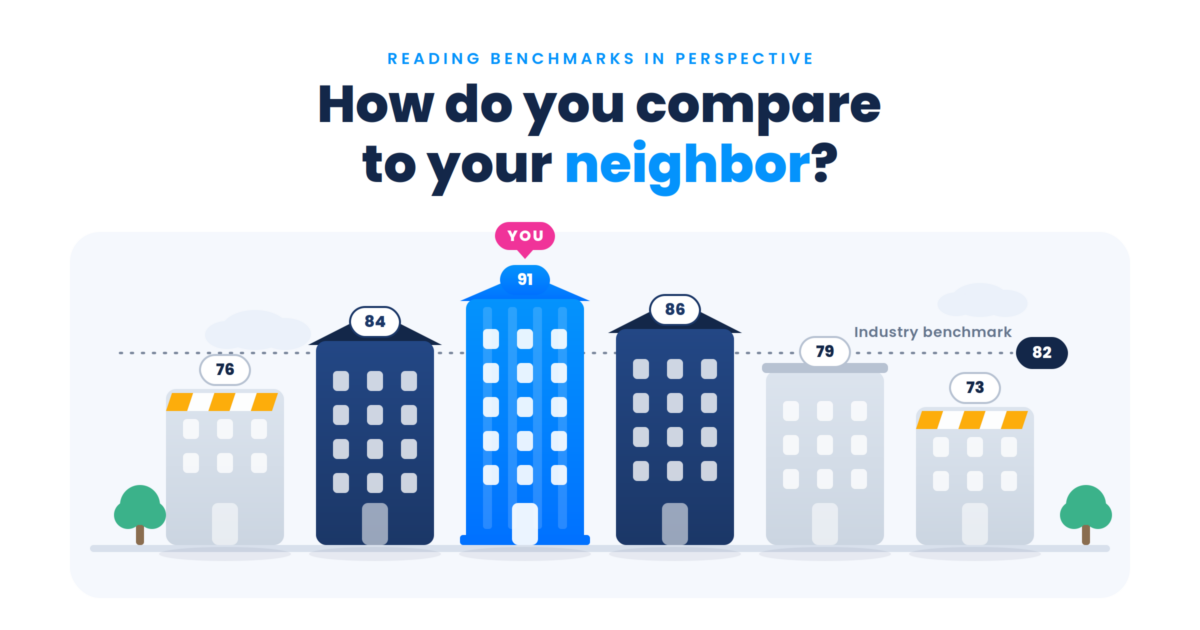
Benchmarking helps community financial institutions (CFIs) avoid reacting too quickly to an individual number, or treating every result as equally important. Customer feedback is most useful when leaders understand what their scores actually mean, and reading benchmarks in perspective can help CFIs decide on appropriate next steps.
Benchmarking also helps them avoid two common reactions: Responding too quickly to an individual number without knowing it’s actually unusual, and treating every score as equally urgent.
A HIGHER SCORE DOESN’T TELL THE WHOLE STORY
It’s easy to look at a set of survey results and immediately focus on the lowest number. It’s a reasonable reaction; lower scores naturally draw attention and prompt questions:
- Why is that number so low?
- How can we increase it?
However, various questions and touchpoints may have different expected ranges. A lower score in one area may still be well within the industry benchmark, while a slightly higher score elsewhere may warrant more attention when compared to similar institutions or experiences.
Take, for example, cross-selling. A high score related to frontline staff discussing additional products might seem like a good thing at first, as it suggests employees are actively looking for opportunities to connect account holders with more services. But if that number climbs too high, it could indicate the team is raising the topic with every account holder, during nearly every interaction, even if the cross-selling conversation is irrelevant to the account holder’s needs. Over time, that approach can weaken the client experience.
When a CFI doesn’t have an external point of comparison, it may risk time and resources attempting to improve a score that’s already within a healthy range. Benchmarking helps the organization avoid those kinds of actions.
NOT EVERY SCORE NEEDS URGENT ATTENTION
Another area we’ve seen CFIs focus too intensely on is in wait and contact center hold times. In this example, a branch or contact center performing far above benchmark may be delivering a great experience. At the same time, the result can prompt a conversation about resource allocation:
Is the CFI investing more than necessary to maintain that particular service level? Could some of those resources support a touchpoint where the client experience is falling behind?
One note of caution regarding benchmarks is that while they provide a valuable point of comparison, they should not be treated as automatic targets. The culture and relationships of your specific institution still matter; if your account holders are used to 40-second wait times, moving suddenly to three minutes because the benchmark says it’s technically acceptable can harm the relationship you have with them.
The goal is not to match every benchmark exactly. It is to use benchmarks to ask better questions about what the results mean for your organization.
INTERNAL AND EXTERNAL BENCHMARKS WORK TOGETHER
External benchmarks are especially useful in an early listening program, when a CFI doesn’t yet have enough historical data to evaluate its own trends over time. They provide an initial point of comparison and show how the CFI’s results align with those of its peers. As a listening program matures, though, the CFI’s own historical data becomes increasingly valuable. Internal benchmarks show how quickly scores across touchpoints are changing, or if they’re changing at all.
In short, external benchmarks show where your institution stands, while internal benchmarks show where it’s going.
Ultimately, a mature listening program benefits from both. A CFI may be improving steadily compared with its own past results, while still trailing its peers in an important area. Conversely, a score that appears flat internally may be quite strong when viewed against the broader industry. Together, internal and external benchmarks provide a more complete view, and can help leadership recognize progress and identify meaningful gaps and opportunities.
TURN BENCHMARKS INTO ACTION
Benchmarks provide valuable context, but interpreting them still requires an understanding of both the organization and the account holder experience behind the score.
Avannis works exclusively with financial institutions and brings decades of experience collecting, comparing, and interpreting client feedback. Our team helps CFIs understand how their results compare with similar organizations, identify which findings deserve closer attention, and turn benchmark data into practical next steps.
Ready to see what your benchmarks really mean? Schedule a demo to get started.
For a closer look at putting those comparisons to work, see how financial institutions can use industry benchmarking to stay ahead of the competition.