
A Closer Look at Compensation in Community Banking
Compensation and benefits have become an important, and often challenging, area of focus for community financial institutions (CFIs). Hiring and retention remain highly competitive, with leadership teams focused on both retaining tenured employees and attracting new talent.
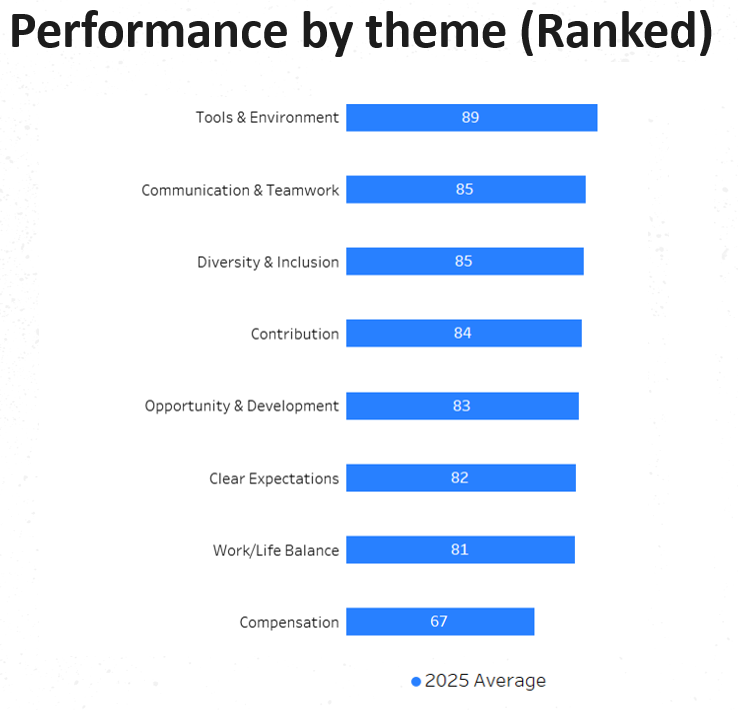
This was particularly evident in findings from the 2025 Independent Community Bankers of America (ICBA) Compensation and Benefits Report, managed by Avannis. The study showed that overall satisfaction with compensation and benefits has improved modestly, but it still ranks as the lowest-scoring area of employee engagement.
Avannis recently shared some of the report’s findings around compensation and benefits at ICBA Live State of the Union. Let’s take a closer look at what the data shows.
THE EMPLOYEE VIEW ON COMPENSATION IN 2025
In 2025 aggregate data, compensation was the lowest-rated category overall:
Still, there are signs of progress. For example, the percentage of employees who report being extremely satisfied with their compensation has increased from 68% to 71%, suggesting some institutions are making headway.
A closer look reveals that satisfaction has improved in certain areas:
- Wages are increasingly viewed as competitive (up from 63% to 70%).
- Performance-based bonuses have jumped (76% to 90%).
Yet several perception metrics have remained flat or declined:
- “I feel fairly compensated” was down from 62% to 61%.
- “Benefits are competitive” was down from 70% to 67%, likely influenced by rising health insurance premiums.
This dynamic is familiar: institutions may be improving compensation structures, but employee perception isn’t always moving at the same pace. In many cases, the gap comes down to having a more complete picture of how compensation compares — something peer comparison data can help provide.
THE IMPORTANCE OF PERCEPTION
A CFI may feel its pay is competitive, but additional factors — including how wages compare to similar roles at other institutions, and whether increases are keeping up with inflation — influence how employees evaluate overall compensation. The study found that, on average, only 28% of institutions adjust base pay for geographic differences.
In light of this, even a well-intentioned compensation package can feel out of step with employee expectations. Survey feedback reinforces this point, with comments reflecting concerns that wages are not keeping pace with inflation, or that compensation doesn’t fully reflect the demands of the role. There are also consistent perceptions — whether accurate or not — that similar positions at other banks offer higher pay.
At the same time, a smaller group of institutions receives strong marks for compensation. This begs an important question: how effectively is above-market compensation leading to outcomes like improved retention or stronger employee performance?
Compensation is not just about how pay and benefits are structured, but how they are understood by employees. Access to reliable peer comparison data can close that gap. It provides a clearer understanding of how compensation is experienced across the industry, giving leadership a stronger foundation for decisions around pay and retention.
A CLOSER LOOK AT THE ICBA REPORT
The ICBA Compensation and Benefits Report is designed specifically for CFIs, and provides a detailed view of compensation across more than 200 roles, segmented by asset class and region. The study also includes more than 100 theme-based questions related to broader HR challenges, including retaining key employees and managing rising benefit costs. These insights also highlight broader workforce trends across the industry.
All data is structured in accordance with ICBA guidelines, with reporting segmented across five US regions. This ensures the information remains actionable and compliant with antitrust regulations.
The full report includes:
- A live Avannis dashboard with the option to view, download, and segment the 100 questions in a number of ways (to align with institution type).
- A PDF summary report of the 100 questions found in the live Avannis dashboards.
- An Excel report with compensation average values for base, incentive, and bonus pay for ~260 roles.
BETTER INSIGHT BEGINS WITH BETTER DATA
Without reliable, market-aligned data, it can be difficult to know whether an institution’s compensation is truly competitive. A clearer view of the market provides the visibility leadership needs to make informed decisions and help align pay with market expectations and improve employee perception of said pay.
That’s one reason many CFIs choose to participate in the ICBA compensation study. Enrollment for the next survey is open through May 8, 2026, with participation taking place later in May. There is no cost to enroll and participate, and contributing to the study helps strengthen the amount of data that CFIs rely on to build and evaluate their compensation packages.
The final report — which is available in September — provides detailed benchmarking across a range of roles, along with insights into broader HR challenges facing the industry. Participating institutions also receive a $500 discount on the full report.
If an institution is still on the fence about purchasing the report, enrollment is an easy way to keep options open. Access to this level of data can provide invaluable clarity for compensation planning and broader workforce strategy.
Pay structure only works if your team understands it, so it is worth asking whether you can explain your incentive pay to your staff.